| ||||||||||||||||||||||||||||||||||||||||||||||||
 | ||||||||||||||||||||||||||||||||||||||||||||||||
|
login
|
 |
 |
 |
||
 |
|
 |
||
 |
 |
 |

|
|
|
|||||||||||||||||||||||||||||||
|
THE INTERPLAY OF RENOVATED SCHOOLS AND PUPILS' HEALTH AND ATTAINMENT Our research focuses on the relationship between the conditions of school buildings and pupils’ health, behaviour and attainment. Our analysis of the relevant literature shows that there is relatively little evidence of research related to the impact of school buildings on teaching and learning in the UK. The only study we can rely on was undertaken by the Department for Children, Schools and Families (2007, p.13) for the project “Building Schools for the Future.” This study suggests that “there is a clear link between the condition of school buildings and levels of attainment. Newer and better school buildings contribute to higher levels of pupil attainment. There is also evidence to suggest the positive effect of improving buildings in ‘poor’ condition.” Being concerned with the current state of British schools this department states that only 14% of schools in the UK currently operate from buildings constructed since 1976. Most of the schools' stock built between the 1950s and the 1970s is already into its replacement period, as their life span is between 30 to 35 years. Maintenance of these buildings is costly and they are unsuitable for modern school use.
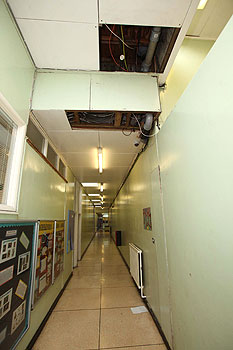
Taking into account the fact that the UK economy is suffering at a level comparable with the post World War II era, schools' budgets reflect this reality. Such factors as crumbling walls, damaged ceiling tiles, inadequate ventilation, poor lighting, inoperative heating and air conditioning systems, noise, overcrowding and poor air quality are reported by many schools in the UK (DCSF, 2005). In order to complete our research on the impact of schools building on pupils’ health and performance, we have referred to the available research undertaken in different countries. A considerable amount of research has been conducted in the USA. The USA studies demonstrate positive correlation between the quality of a school building and pupils’ health and attainment. The Environmental Protection Agency (2000) conclude that the poor condition of a school building causes so-called “sick building syndrome” which increases cases of asthma and other related illnesses in pupils. Younger children are more vulnerable to the physical environment which has a more detrimental and serious effect on their health.
Another identified threat is related to old asbestos in schools. Asbestos was widely used in schools as a fire protection material in the 1960s and 70s. Although the use of asbestos was banned in 1999, most schools contain this material. The HSE (2006) classifies asbestos dust as dangerous to children and teachers. The HSE (2006) states that “the number of deaths from mesothelioma among school teachers is far higher than one should expect in what appears to be a low risk occupation. Extensive research in this area has been undertaken by the Campaign “Asbestos in Schools” (2006, p.5). They conclude that “The HSE have not given an estimate of how many children have been exposed by asbestos at school and have died as a result. However, if one considers the number of teachers who have died from asbestos related cancers, the greater numbers of children and their particular vulnerability to asbestos, then it is probable that a significant number of children are exposed to asbestos at school and die as a result.” the vast amounts of statistical information provided by the Campaign are shocking.
To the category of invisible killers, we can add old lead-based paint. Lead-based paint and its dust can cause lead poisoning. The dust is hard to see, as are the immediate results of lead poisoning. The Healthy Homes warns parents that there are no reliable symptoms of lead poisoning that can help parents detect the problem soon. The visible symptoms of brain damage, poor physical growth and development, social and behavioural problems and learning disabilities come too late, however, repainting walls falls into a category of building improvements which do not require substantial financial investment.
A vast majority of case studies confirm that such structural factors as heating, lighting, air-conditioning, temperature, cleanliness, acoustic enhancement, safety features and refurbished premises influence pupils’ health and performance. Numerous studies undertaken in the USA suggest that a high temperature of 75F causes an increase in body temperature, pulse rate and a marked fall in vasomotor tone, producing harmful physiological effects. Concerning the air quality, the study confirms that the increased content of CO2 in the indoor air is detrimental to pupils’ health as it triggers asthma and other health hazards. The study provides good evidence that lack of proper ventilation inhibits pupils’ performance and achievements. Health hazards come from poor lighting and bad acoustics as these can impair vision and mental health. (Smedje and Norback, 1999) These studies confirm the profoundly detrimental impact of school buildings in disrepair on pupils’ health. Yet more studies have evaluated pupils’ learning in new or refurbished schools in comparison with learning in old schools. Earthman (2004) provides an analysis and synthesis of numerous studies in the USA related to the relationship between schools’ conditions and pupils’ learning. This author suggests that the learning environment can be thought of as composed of different dimensions: the physical, social and cultural. Schools are systems in which the physical environment is one of many interacting factors, which impacts on pedagogical, socio-cultural, curricular, motivational and socio-economic factors. A large corpus of research findings establishes the following relationship: · Pupils in modern buildings did significantly better in reading, listening, language and arithmetic than pupils in the older facilities. · Discipline was needed less frequently in the new facilities compared to less desirable physical environments. · Pupils in the newer buildings had significantly higher attendance records and better health records. · The self-concept of the pupils in the newer facilities were better than the self-concept of those students in the older schools.
There are a few cases in the UK confirming the USA research. The head teacher survey undertaken by the DCSF (2007) shows that the new or refurbished buildings are enabling their schools to improve relationships with parents. "There are positive benefits from new and refurbished facilities. It also provides us with more evidence about improvements in pupil attitudes, aspirations and behaviour; staff morale, recruitment and retention; and better access to school facilities for all members of the local community." A good example is Joseph Chamberlain Sixth Form College. This college which is situated in a particularly disadvantaged area of Birmingham won Prime Ministers Better Public Building Award in 2009. Its principal, Elly Tobin, told CABE: “Never in their wildest dreams would these young people have expected such a wonderful building. It makes them feel proud and good about themselves. It gives them a sense of their place in the community and a sense of responsibility. They have been given something special and they want to do well and give something back.” Another excellent example of improved learning, teaching and overall academic performance is Whitecross High School and Specialist Sports College. The renovation of this building was completed in accordance with the BFS in June 2006. We compared Ofsted inspections taken in September 2006 and December 2009. The Ofsted grading criteria are as follows: Grade 1 Outstanding Grade 2 Good Grade 3 Satisfactory Grade 4 Inadequate
This case clearly shows the outstanding achievement of the pupils after the renovation of the school. Teaching has gone from being satisfactory to good. This demonstrates the teachers’ motivation to provide better quality teaching. The Ofsted inspectors commented that “Students are often seen around school working industriously with no direct supervision.” The report also outlines the outstanding contribution of pupils and the school and wider community. One parent said(2009):
Experience with renovated schools has already demonstrated the great impact of such schools on local communities. It has been confirmed that renovated schools become centres of the communal life. When schools' appearance is inviting, pupils, teachers and the local community want to be there. Summarising our findings, we confirm that numerous studies indicate that pupils in poor buildings can be exposed to a variety of health hazards and that they also perform less well than pupils in refurbished or renovated buildings. Parents should also bear in mind that in addition to the damaging effect that poor and old facilities have on pupils’ achievement, failure to improve a demonstrably old and failing facility may convey a message to children that the system values them less than it does other children who are perceived as more advantaged and valued. It can be concluded that school buildings in disrepair cause a detrimental psychological effect on children as well as a profound danger to their health. By embracing all of the benefits from renovated schools with an end result such as healthy, happy and performing pupils growing in a cohesive community, we commit ourselves to serving society and investing in future generations. References: Asbestos in Schools http://www.asbestosexposureschools.co.uk/
Earthman, G. (2004) Prioritisation of 31 criteria for school building adequacy http://www.schoolfunding.info/policy/facilities/ACLUfacilities_report1-04.pdf
Environmental protection agency (www.epa.gov)
Evaluation of Building Schools for the Future (BSF) 3rd Annual Report final Report http://www.teachernet.gov.uk/_doc/14728/DCSF%20-%20BSF%20Year%203%20Final%20Report.pdf Healthy homes: For Parents: Lead Poisoning http://www.healthyhomescoalition.org/lead/for-parents-lead/ HSE website http://www.hse.gov.uk/
Smedje, G.& Norback, D (1999) "The School Environment: Is It Related to the Incidence of Asthma in the Pupils?" In Indoor Air '99. The Eighth International Conference on Indoor Air Quality and Climate. vol.5. pp.445-450.
|
|
|||||||||||||||||||||||||||||||
|
|
|